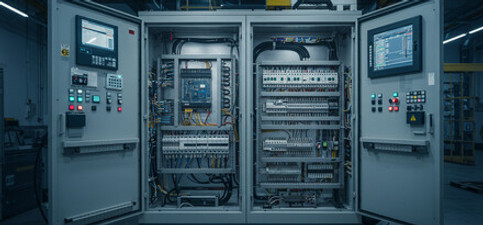
Automation Design Project with PLC Programming
Duration: 40 Hours
Expert
Course Overview
This Expert-level program (Level 3) focuses on real-world automation project design using Rockwell/Allen-Bradley PLCs, VFDs, HMIs, and industrial networks. Unlike earlier levels, this course is project-driven: participants apply their advanced programming and integration knowledge to design, configure, and troubleshoot complete automation systems.
Through hands-on case studies, learners will replicate industrial practices such as MCC integration, process control, and automated material handling. By the end, participants will have the skills to deliver end-to-end industrial automation solutions aligned with industry standards.
Learning Outcomes
By the end of this course, participants will be able to:
-
Design, configure, and deploy complex industrial automation projects.
-
Integrate Rockwell PLCs, VFDs, and HMIs for complete automation solutions.
-
Apply advanced process control techniques (PID, cascade loops, device calibration).
-
Implement PLC-to-PLC communication for distributed control architectures.
-
Troubleshoot, document, and validate systems using FAT/SAT procedures.
-
Optimize automation systems for safety, reliability, and efficiency.
Course Content
Module 1: Expert PLC Project Development
-
Project planning, I/O allocation, and architecture design.
-
Advanced PLC programming standards: UDFBs, structured text, ladder logic.
-
Interlocks, safety logic, and redundancy strategies.
-
PLC-to-PLC communication and distributed control.
Module 2: Motor Control Centers (MCC) & Drives
-
Design and integration of MCCs with Rockwell PLCs.
-
Commissioning and tuning Variable Frequency Drives (VFDs).
-
MCC interlocking schemes and protection systems.
-
HMI integration with PanelView for monitoring and control.
Module 3: Process Automation & Control
-
Advanced process control loops (PID, cascade, ratio control).
-
Analog sensor/actuator integration: scaling, calibration, diagnostics.
-
HMI–PLC communication for real-time data monitoring.
-
Simulation, Factory Acceptance Testing (FAT), and Site Acceptance Testing (SAT).
-
Documentation: I/O lists, system architectures, compliance standards.
Module 4: Automated Conveyor & Material Handling Systems
-
Conveyor sequencing with PLC logic (start/stop, load balancing, safety).
-
Integration of barcode/RFID systems for product tracking.
-
Load management, throughput monitoring, and alarm handling.
-
Designing operator-friendly HMI dashboards for conveyor monitoring.
-
Performance analysis and system optimization.
Module 5: System Validation, Troubleshooting & Optimization
-
Real-world debugging of industrial automation systems.
-
Network troubleshooting (Ethernet/IP, ControlNet).
-
Alarm and diagnostic system optimization.
-
Project validation workflows and compliance reporting.
-
Continuous improvement for system reliability and efficiency.
Case Studies (Hands-On Projects)
🔹 Case Study 1: Motor Control Center (MCC) Integration
-
Design and configure a Rockwell-based MCC with PLC–VFD integration.
-
Deploy PanelView HMI for motor control, alarms, and diagnostics.
-
Implement PLC-to-PLC communication for distributed motor operations.
🔹 Case Study 2: Process Control System
-
Program advanced PID and cascade loops for temperature, pressure, or flow regulation.
-
Integrate analog sensors/actuators with scaling and calibration.
-
Validate system performance using FAT/SAT with proper documentation.
🔹 Case Study 3: Automated Conveyor System
-
Develop a warehouse conveyor system with sequencing, interlocks, and safety logic.
-
Integrate RFID/barcode devices for item tracking.
-
Configure HMI dashboards with real-time trends and alarms.
-
Analyze throughput data to optimize conveyor efficiency.
General Skills Developed
-
Expert-level Rockwell PLC programming (Studio 5000, ControlLogix, CompactLogix).
-
Advanced HMI development with PanelView for industrial applications.
-
Communication network setup and troubleshooting (Ethernet/IP, ControlNet).
-
Integration of VFDs, analog/digital I/O modules, and field devices.
-
System validation through FAT/SAT methodologies.
-
Industrial project documentation, compliance, and reporting.
-
Real-world troubleshooting, optimization, and performance improvement.